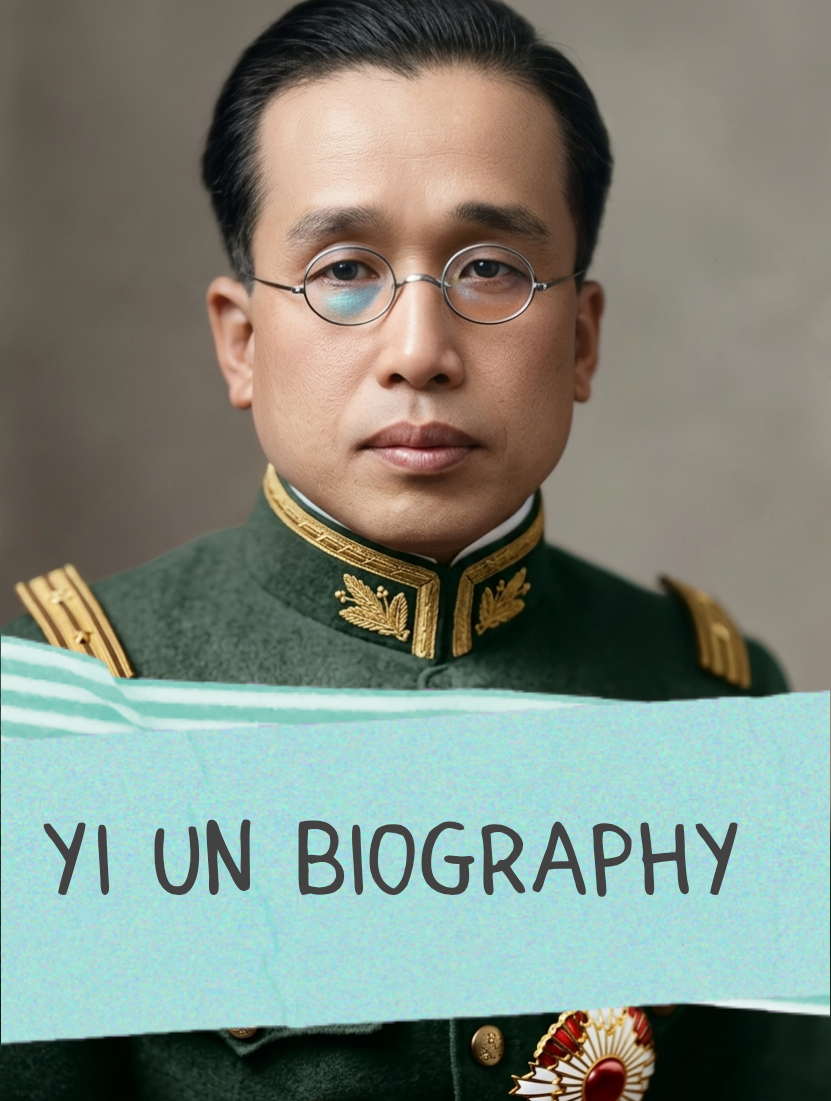
Yi Un Biography
Yi Un, also known as Crown Prince Uimin or Euimin, was the last imperial crown prince of the Korean Empire and a high-ranking general in the Imperial Japanese Army. Born into the royal House of Yi during a time of profound political upheaval, he lived through the final years of Korean sovereignty, the Japanese annexation, two world wars, and the division of modern Korea. His life reflected the complex interplay of Korean royal heritage and Japanese imperial influence, marked by privilege, duty, exile, and eventual return to his homeland in declining health.
As the 28th head of the Korean Imperial House, Yi Un held symbolic importance for many Koreans even after the empire’s fall. His military career in the Japanese forces and his arranged marriage to a Japanese princess underscored the colonial-era policies aimed at integrating Korean royalty into the Japanese system. Despite these circumstances, he maintained a connection to Korean traditions and later sought to live out his final years in Seoul. His story offers insight into a turbulent chapter of East Asian history, blending personal resilience with the broader forces of imperialism and nationalism.
Yi Un Full Name: Yi Un (Korean: 이은; Hanja: 李垠), posthumously titled Crown Prince Uimin (의민황태자; 懿愍皇太子). He was also referred to as Prince Imperial Yeong and, briefly, King Yi of Changdeokgung.
Yi Un Place of Birth: Deoksugung (Deoksu Palace), Seoul, Korean Empire.
Yi Un Nationality: Korean (with periods of Japanese imperial affiliation and later statelessness before regaining citizenship ties).
Yi Un Early Life
Yi Un was born on 20 October 1897 at Deoksugung in Seoul. He was the seventh son of Emperor Gojong, the Gwangmu Emperor, and his mother was Imperial Noble Consort Sunheon (born Eom Seon-yeong), a palace attendant who received posthumous honors. As a member of the House of Yi, he grew up in the royal court amid growing foreign pressures on Korea.
In 1900, at the age of three, he received the title Prince Imperial Yeong. By 1907, despite having an older half-brother, Prince Imperial Ui, he was named crown prince. This decision stemmed from political considerations, as Prince Ui’s position was weakened after his mother’s death. The move came after the Hague Secret Emissary Affair, in which Emperor Gojong attempted to appeal to international powers against Japanese influence.
In December 1907, Japanese statesman Itō Hirobumi took the young prince to Japan under the guise of education. This relocation aimed to prevent potential anti-Japanese activities in Korea. Yi Un enrolled at Gakushūin Peers’ School in Tokyo, where Emperor Meiji served as his guardian. There, he interacted with Japanese imperial princes, including the future Emperor Hirohito. He visited Korea infrequently, returning once after his mother’s death in 1911. These early years shaped a life divided between Korean roots and Japanese upbringing.
Yi Un Age
Yi Un lived for 72 years, from his birth in 1897 until his death in 1970. His lifespan spanned the end of the Joseon Dynasty’s imperial phase, the full period of Japanese colonial rule over Korea (1910–1945), World War II, and the early decades of the Republic of Korea. He reached adulthood during a time when Korea had lost its sovereignty, and he spent much of his prime years serving in the Japanese military while holding a nominal royal title.
Yi Un Education
Yi Un received a formal education tailored to Japanese imperial standards. After arriving in Japan in 1907, he attended Gakushūin Peers’ School. In September 1911, he entered the second year of the Army Central Youth School in Tokyo. He demonstrated strong academic performance and graduated from the 29th class of the Imperial Japanese Army Academy on 25 May 1917. Continuing his military training, he completed the 35th class of the Army Staff College in November 1923. His education emphasized military discipline, strategy, and leadership, preparing him for a career in the Imperial Japanese Army.
Yi Un Career
Yi Un pursued a distinguished military career within the Imperial Japanese Army, rising through the ranks over nearly three decades. Commissioned as a second lieutenant in the infantry on 25 December 1917, he advanced steadily: lieutenant in April 1920, captain in July 1923, major in August 1928, lieutenant colonel in August 1932, colonel in August 1935, major general in July 1938, and lieutenant general in December 1940.
His early assignments included commanding a battalion in the Guards 2nd Infantry Regiment and serving on the Imperial Japanese Army General Staff Office from December 1924. In July 1926, he joined the staff of the Chosen Army. By August 1929, he commanded the IJA 1st Infantry Regiment. He later served as an instructor at the Army Academy starting in April 1937.
During the Second Sino-Japanese War and World War II, his roles expanded. In December 1938, he joined the North China Area Army staff. He commanded the Guards 2nd Brigade from August 1939 and the Fourth Depot Division from May 1940. In July 1941, he took command of the IJA 51st Division, which operated in Manchukuo and Guangdong, China. From July 1943, he led the 1st Air Army, and in April 1945, he became a member of the Supreme War Council.
These positions placed him at the heart of Japanese military operations in Asia. He received the Grand Cordon of the Supreme Order of the Chrysanthemum for his service. After Japan’s surrender in 1945, his military career ended with the dissolution of the Imperial Japanese Army. Postwar, he faced the loss of his Japanese royal titles under Article 14 of Japan’s new constitution in 1947, leaving him stateless for a time before acquiring Japanese citizenship in 1947 (with adjustments noted in records around 1957).
Yi Un held significant titles throughout his life. After the 1910 annexation of Korea by Japan and Emperor Sunjong’s forced abdication, he retained the status of Crown Prince of Korea. Upon Sunjong’s death on 10 June 1926 (with formal succession noted from 24 April 1926), he became known as King Yi of Changdeokgung, though this was largely ceremonial and as a pretender, given Korea’s integration into Japan. Posthumously, he received the title Crown Prince Uimin from the Jeonju Lee Royal Family Association.
Yi Un Recent News
As a historical figure who passed away in 1970, Yi Un does not feature in current news cycles. However, his legacy occasionally surfaces in discussions about Korean royal history, Japanese colonial rule, and cultural representations. For instance, he was portrayed by actor Park Soo-young in the 2016 South Korean film “The Last Princess,” which highlighted aspects of the royal family’s experiences. Interest in the House of Yi persists through heritage sites like Changdeokgung Palace and efforts to preserve royal tombs. Modern reflections often focus on the human stories behind colonial-era figures rather than active developments.
Yi Un Personal Life
Yi Un’s personal life was deeply influenced by political arrangements and the challenges of his era. He married Princess Masako of Nashimoto (later known as Yi Bangja or Crown Princess Bangja) on 28 April 1920 in Tokyo. The union was arranged to strengthen ties between Korean royalty and the Japanese imperial family amid colonial policies. Princess Masako, born on 4 November 1901, came from the Nashimoto branch of the Japanese imperial family. She stood by her husband through decades of military service, wartime hardships, exile, and illness, earning respect for her loyalty and adaptability. She lived until 30 April 1989.
The couple faced personal tragedies. Their first son, Yi Jin, born on 18 August 1921, died on 11 May 1922 at less than a year old during a family visit to Korea. The sudden death sparked rumors and added to the emotional strain of their lives under colonial oversight. Their second son, Yi Gu, born on 29 December 1931, survived and later became the 29th head of the Korean Imperial House. Yi Gu married Julia Mullock, an American, in 1959 and had no biological children but adopted a daughter. He passed away in 2005.
Yi Un experienced health issues in his later years, including a stroke in March 1959 and cerebral thrombosis. These conditions limited his activities, yet he maintained connections with family and made international trips when possible, including visits to the United States and Hawaii. After returning to Korea in 1963, he lived quietly at Nakseon Hall in Changdeokgung Palace alongside his wife and his sister, Princess Deokhye. His days involved rest and reflection, far removed from the military command and royal pomp of earlier times.
Yi Un Family
Yi Un belonged to the prominent House of Yi, descendants of the Joseon Dynasty rulers. His father, Emperor Gojong, led Korea during a critical transition period, while his half-brother Emperor Sunjong was the final reigning monarch before annexation. Key family members included his mother, Imperial Noble Consort Sunheon, and siblings such as Prince Imperial Ui.
His immediate family centered on his wife, Yi Bangja, and their two sons. The loss of their firstborn highlighted the vulnerabilities of royal life in that period. Yi Gu continued the family line as head of the house, though without reclaiming political power. Extended relatives, including other princes from Gojong’s lineage, formed a broader network that navigated the post-imperial era. The family endured displacement, loss of status, and the complexities of divided loyalties between Korean identity and Japanese affiliations. Today, descendants and royal associations continue to honor the lineage through cultural and commemorative activities.
Yi Un Net Worth
Estimating Yi Un’s net worth in modern terms is challenging due to the historical context and the symbolic rather than economic nature of his royal and military positions. During the Japanese colonial period and his service in the Imperial Japanese Army, he enjoyed privileges associated with high rank, including residences and support from imperial resources. Properties like the Kitashirakawa Palace in Tokyo (later repurposed) reflected some assets tied to his status.
After World War II, he lost many formal titles and faced periods of uncertainty, including statelessness. His later life in Korea involved residence in a palace hall provided through governmental arrangements under President Park Chung Hee. No public records detail significant personal wealth accumulation, as his role was primarily ceremonial and military rather than commercial. Any assets would have been modest by contemporary standards, focused on family support and basic needs in his final years. Historical biographies emphasize his legacy in heritage and history over financial details.
Conclusion
Yi Un’s life encapsulated the dramatic shifts in 20th-century Korea, from imperial glory to colonial subjugation and postwar recovery. As the last crown prince, he symbolized a lost era of Korean sovereignty while serving loyally in the Japanese military system that had dismantled it. His arranged marriage, extensive military commands across Asia, personal losses, and eventual return to Seoul paint a portrait of duty, adaptation, and quiet endurance.
Though he held titles without real power in later decades, his story resonates as a reminder of how individuals navigate larger historical forces. The House of Yi’s enduring cultural significance in South Korea today owes something to figures like Yi Un, who bridged old traditions and modern realities. His burial at Yeongwon Hongneung in Namyangju places him among other royal ancestors, ensuring his place in national memory.
FAQs
Who was Yi Un?
Yi Un was the last imperial crown prince of the Korean Empire, a lieutenant general in the Imperial Japanese Army, and the 28th head of the Korean Imperial House. He lived from 1897 to 1970 and experienced the annexation of Korea, world wars, and the early years of the Republic of Korea.
When and where was Yi Un born?
He was born on 20 October 1897 at Deoksugung in Seoul, during the Korean Empire.
What was Yi Un’s role in the Japanese military?
Yi Un rose to the rank of lieutenant general and held commands including the 51st Division and the 1st Air Army. He participated in operations during the Second Sino-Japanese War and World War II.
Who did Yi Un marry?
He married Princess Masako of Nashimoto (Yi Bangja) in 1920. She was a Japanese noblewoman who became crown princess and supported him throughout his life.
Did Yi Un have children?
Yes, he had two sons: Yi Jin, who died in infancy in 1922, and Yi Gu, who succeeded him as head of the house and lived until 2005.
When did Yi Un return to Korea?
After being denied entry initially by President Syngman Rhee, he returned in November 1963 under President Park Chung Hee, arriving in poor health. He lived at Changdeokgung Palace until his death.
How did Yi Un die?
Yi Un died on 1 May 1970 at Nakseon Hall in Changdeokgung, Seoul, due to complications from cerebral thrombosis and declining health. He was 72.
What is Yi Un’s legacy?
His legacy lies in representing the final chapter of the Korean Empire and the complexities of royal life under colonialism. He is remembered through historical accounts, family succession, and cultural depictions, highlighting themes of identity, duty, and resilience in Korean history.